Nutella is one of my favorite ingredients: I love it on toast, in cupcake frosting, and anything else you can think of to use it in creatively (Udita keeps going on about frozen Nutella hot chocolates which I have yet to try but sound amazing, if not a total oxymoron).
In the mood for a coffee cake that would go well with a cup of hot steaming black Illy, I thumbed through the pages of my newly purchased BBC GoodFood 101 Cakes & Bakes (a bargain at £3.48 from Amazon) and found this quick and easy recipe. I love this recipe book because it's about the size of my palm and is perfect for those days where you just want to make a simple variation of a sponge cake and not necessarily grand cakes of Hummingbird or Magnolia proportions (not to mention that the instructions are basically, "dump all the ingredients in a bowl. Mix, bake, enjoy."). Perfect for lazy days (I'll leave the macaroon making for next weekend, Shirin - perhaps).
For some reason, my Nutella settled on the bottom of the cake (which you can see in the picture), so I think I'll have to "swirl" it a little more thoroughly next time. Otherwise, it tasted great and went well with the black coffee. I'd encourage you to "give it a go," as people say in this country.
Saturday, July 31, 2010
Thursday, July 29, 2010
Falls Short On Substance: "Short Girls" by Bich Minh Nguyen
If I hadn't read Bich Minh Nguyen's bio and seen the litany of awards she's received for her work, I'd think she was a twenty-something writer who just graduated from some creative writing course at some liberal arts college in Cali or the East Coast. I was surprised - no, shocked - to discover that she actually teaches creative writing at a university. And then I realized that her professorship speaks volumes of the state of Asian-American literature and the study of Asian-American literature today.
You see, I think the market for Asian-American writing and stories is so incredibly starved that editors, publishers and even Asian-Americans, will jump at the newest-thing-since-Amy-Tan (who isn't even good and actually infuriates me, but that's another story for another time). I mean, I jumped. I read the blurb on the back jacket and thought, hey, maybe this will be it - maybe this will be that amazing tale of the struggle Asian-American women face in seeking their identity through their families, friends and partners (past and present). Maybe this will be that book I've been waiting for - that thing writers like Amy Tan didn't get. I thought I'd finally found a book I could personally relate to.
The premise of the story revolves around two sisters, Van and Linny, who are supposed to be polar opposites - one, outgoing, beautiful and laid back, the other, introverted, uptight and ordinary looking. Both return home to help celebrate their inventor father's oath of American citizenship as he plans to submit his invention, the "Luong Arm" (a device that enables those who are vertically challenged - notice I did not use the word short, hehe - to "grab" objects from unattainable heights), to a reality TV show contest. And surprise, surprise, each sister has a "secret" about her personal (read: love) life she is hiding from the other out of pride, fear, or both. Sound like an absolute mish-mash of conflicting and incongruous ideas? It is.
I've never been more disappointed. Not only is the prose itself static, stilted and - for lack of a better word - dull, both characters (sisters, who were supposed to be foils to one another) have as much personality as a limp dish-rag. You know, which is, like, perfectly fine if that's what you intended. But somehow, I don't think it's what Nguyen was aiming for. Furthermore, any remote semblance of personality injected into either sister was scripted and cliched beyond belief. But perhaps the biggest flaw in the novel (and my personal gripe) is Nguyen's perpetual failure to "show, rather than tell" - that age-old adage every single creative writing professor, no, high-school English teacher throws at her students on the first day of class. We are repeatedly subjected to new characters who are introduced in a formulaic "this is so-and-so. I know him from such-and-such. He used to be like this. Now he does that. My opinion of him is this. He is a [insert categorical stereotype here, e.g. goth, punk, hipster, etc.]." And yes, she really does this (if you want page numbers, I can give them to you, because I folded over each page where this occurs).
I know I haven't been particularly generous here. But what I will give kudos to Nguyen for, however, is the insight to address the complexity of an Asian-American identity that is grown and developed in small-town America. She successfully highlights the paradox of desperately wanting to fit into the so-called "white" and/or "Vietnamese" community but not being able to feel a sense of belonging or loyalty to either through Van's tendency to shrink deeper, deeper within herself to escape these pressures. She illustrates the painful relationships many first and second generation Asian-American children have with their parents through Van's and Linny's pleading attempts to gain their father's approval (or at least some show of affection or love) and his blatant refusal to give them either. And it's not done in a cold-hearted way, but performed rather as a denial. A lack thereof. That's the stereotypical (but often true) Asian-parent way. When Van informs her father of her imminent divorce from her controlling, manipulative husband, her father immediately blames her, saying, '"I like Miles ... he's a nice guy. What did you do?" A troubled look spread over Mr. Luong's face and stayed there. He didn't offer anything more - not an I'm sorry or what happened or what can I do, the normal American things people were supposed to say.' It's Van's and Linny's constant hunt for so-called "American normalcy" that strikes a chord with me. And even though Nguyen doesn't do it perfectly, she does bring the reader's awareness to (what I believe to be) the core of the Asian-American identity crisis. What does it mean to be normal? In a town where neighbors refer to you as "gooks" (Van's) and laugh at you in Target because "you can't even speak English" (mine)? What does it mean to be American? Asian? Asian-American? There's a lot there that warrants further discussion. Unfortunately, the sheer boredom of reading the book itself overshadows the important issues it raises.
In summary, an amateur effort at best, from a professional. A major disappointment, but highlights some key issues facing the Asian-American community today.
Have you read it? Will you read it? Let me know your thoughts.
Photo source
You see, I think the market for Asian-American writing and stories is so incredibly starved that editors, publishers and even Asian-Americans, will jump at the newest-thing-since-Amy-Tan (who isn't even good and actually infuriates me, but that's another story for another time). I mean, I jumped. I read the blurb on the back jacket and thought, hey, maybe this will be it - maybe this will be that amazing tale of the struggle Asian-American women face in seeking their identity through their families, friends and partners (past and present). Maybe this will be that book I've been waiting for - that thing writers like Amy Tan didn't get. I thought I'd finally found a book I could personally relate to.
The premise of the story revolves around two sisters, Van and Linny, who are supposed to be polar opposites - one, outgoing, beautiful and laid back, the other, introverted, uptight and ordinary looking. Both return home to help celebrate their inventor father's oath of American citizenship as he plans to submit his invention, the "Luong Arm" (a device that enables those who are vertically challenged - notice I did not use the word short, hehe - to "grab" objects from unattainable heights), to a reality TV show contest. And surprise, surprise, each sister has a "secret" about her personal (read: love) life she is hiding from the other out of pride, fear, or both. Sound like an absolute mish-mash of conflicting and incongruous ideas? It is.
I've never been more disappointed. Not only is the prose itself static, stilted and - for lack of a better word - dull, both characters (sisters, who were supposed to be foils to one another) have as much personality as a limp dish-rag. You know, which is, like, perfectly fine if that's what you intended. But somehow, I don't think it's what Nguyen was aiming for. Furthermore, any remote semblance of personality injected into either sister was scripted and cliched beyond belief. But perhaps the biggest flaw in the novel (and my personal gripe) is Nguyen's perpetual failure to "show, rather than tell" - that age-old adage every single creative writing professor, no, high-school English teacher throws at her students on the first day of class. We are repeatedly subjected to new characters who are introduced in a formulaic "this is so-and-so. I know him from such-and-such. He used to be like this. Now he does that. My opinion of him is this. He is a [insert categorical stereotype here, e.g. goth, punk, hipster, etc.]." And yes, she really does this (if you want page numbers, I can give them to you, because I folded over each page where this occurs).
I know I haven't been particularly generous here. But what I will give kudos to Nguyen for, however, is the insight to address the complexity of an Asian-American identity that is grown and developed in small-town America. She successfully highlights the paradox of desperately wanting to fit into the so-called "white" and/or "Vietnamese" community but not being able to feel a sense of belonging or loyalty to either through Van's tendency to shrink deeper, deeper within herself to escape these pressures. She illustrates the painful relationships many first and second generation Asian-American children have with their parents through Van's and Linny's pleading attempts to gain their father's approval (or at least some show of affection or love) and his blatant refusal to give them either. And it's not done in a cold-hearted way, but performed rather as a denial. A lack thereof. That's the stereotypical (but often true) Asian-parent way. When Van informs her father of her imminent divorce from her controlling, manipulative husband, her father immediately blames her, saying, '"I like Miles ... he's a nice guy. What did you do?" A troubled look spread over Mr. Luong's face and stayed there. He didn't offer anything more - not an I'm sorry or what happened or what can I do, the normal American things people were supposed to say.' It's Van's and Linny's constant hunt for so-called "American normalcy" that strikes a chord with me. And even though Nguyen doesn't do it perfectly, she does bring the reader's awareness to (what I believe to be) the core of the Asian-American identity crisis. What does it mean to be normal? In a town where neighbors refer to you as "gooks" (Van's) and laugh at you in Target because "you can't even speak English" (mine)? What does it mean to be American? Asian? Asian-American? There's a lot there that warrants further discussion. Unfortunately, the sheer boredom of reading the book itself overshadows the important issues it raises.
In summary, an amateur effort at best, from a professional. A major disappointment, but highlights some key issues facing the Asian-American community today.
Have you read it? Will you read it? Let me know your thoughts.
Photo source
Wednesday, July 28, 2010
Downtown vs. City Centre
The other day, Udita was in Seattle for a conference and she emailed me to ask whether or not the UW campus was "close to downtown Seattle". I squinted at her message on my Blackberry and had to think for a while - because spending 3+ years living outside of the United States has completely worn down my American vocabulary - more so than you would think - and I momentarily forgot what "downtown" meant. Okay, I didn't forget what it meant, but I found it hard to picture in my mind. What did it look like (more like, which shops were there?)? How far was it from the U-District?
You see, here, what someone might refer to as "downtown" in the States, is known (relatively more or less) as the "city centre". When I first moved to England and lived in York (whose university campus is located "outside" of the "city centre"), the term "city centre" sounded overly formal and peculiar. But now I know it generally refers to where the major "high street" (another British term for where all the popular shops and restaurants - mostly chains - are found) businesses are and find myself referring to wanting to go shopping "in the city centre" when visiting a new place (for the record, Salisbury city centre is immensely disappointing. York is not.).
I had to laugh when my dad came to visit a couple years back and referred to Oxford Street as "the main drag". "Can we go back to the main drag?" he asked, as we were half-way up Regent Street. "What main drag?" I asked, exasperatedly. "You know," he said emphatically, as if waving his hands around would help illustrate his point. "The main drag," he repeated. But in a city the size of London, it's hard to differentiate between the "main drag" of Oxford Street and the other main drags of, say, Marylebone High Street or The Strand. Those could all be considered "main drags". You also never hear someone referring to "downtown London" or "London city centre", because it's simply too big for those definitions.
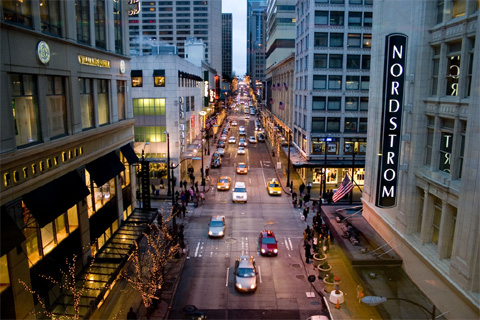
So I felt a hint of nostalgia when Udita's email popped up on my phone. I wouldn't mind being back in a city that had a "downtown" fairly soon (not to mention, a Nordstrom). In the meantime, I'm certainly enjoying the city centres.
Tuesday Morning Tube Rant: Preggers Or Not? That Is The Question.
A colleague of mine walked into work today (I won't mention any names) bemoaning the fact that someone on the tube mistook her food baby for an actual baby last night and gave her her seat. Ouch. We've all been there. Feed me a double stuffed burrito around the right time of the month (or actually, come to think of it, at any time) and I'm guaranteed to look at least five months pregnant. No joke. So we all expressed our shock at my poor friend's humiliating experience and uttered the necessary tut-tuts of sympathy.
... which then naturally led us to the "how can you tell if someone's pregnant or just carrying a bit of extra weight around the tummy" conversation. Now, for anyone who self-righteously announces, "I can always tell. It's obviously very different," puh-lease. Because it is NOT always glaringly obvious when a woman is five months pregnant or simply had a bad day of bloat. We've all heard horror stories of people (mostly from men) who have been berated by pregnant women (and fellow passengers) who failed to give up their seats for a woman with child and similarly, stories (again, mostly from men) of people who have been publicly humiliated by women they have given up their seats for - women who, like you or I, just happened to be suffering from a bit of bloat (or were simply overweight, or had just very recently given birth).
So how can you tell? Advice columns in newspapers chide those of us who have mistaken a bit of stomach fat for a baby as the "firmness" of the bump is what's in question. Um, excuse me, but I have seen-many-a "firm" bumps of fat during my time on public transport. So that won't really help.
One friend claimed she absolutely will not give her up her seat unless she is 100% certain the woman is pregnant. Some women help matters by wearing the "Baby On Board" button (or badge, as you Brits call them), which is apparently available from TFL's Customer Service Centre. Others take the same newspaper's advice that questioned the "firmness" of the bump to drop hints by "leaning against the hand rails and stroking your pregnant belly" (sorry, the phrase "stroking your pregnant belly" just made me throw up in my mouth a little).
So anyways, I like, still don't have an answer to my question. Obviously, I don't want to be the grinch who doesn't give up her seat (it's a pet peeve of mine - people who don't, when necessary) to a pregnant lady - I mean, heck, if I was holding more than just my regular food baby, you'd be sure as heck I'd be hinting in all ways possible for a seat (including stroking my pregnant belly), but at the same time, I don't want to make the same mistake as my friend's seat-giver-upper did, since my friend has now sworn off eating cakes for a while. Ouch.
Tuesday, July 27, 2010
Need New Music? Join Rough Trade's The Album Club (Or Just Trade iPods).
I traded iPods with John the other day and I've never been happier - all of a sudden, the likes of Tupac, Biggie Smalls and These New Puritans were flooding my ears on my commute to work. While I confess I'm not particularly a huge fan of any of the above, the most important thing is that trading iPods gives me access to new music - music that I wouldn't normally listen to and music that I've become addicted to (ahem, Local Natives).
My friend Orianna came up with a great idea via Facebook, which consisted of getting twelve people together (who may or may not know each other) to make mixed CDs for one another. I was assigned the month of April and obviously never got around to it, but having received a mix from someone in Australia this weekend, I've been inspired and have vowed to create mine ... soon.
Anyway, another great way to get new music is to join a CD club, which John has done. Rough Trade Records in Brick Lane (although there are other locations) is the trendiest go-to-place for new music in London. And for £12 a month, you can join The Album Club, which is Rough Trade's pick of the best album releases that month and what they think you should be listening to - and which, might I add, is almost always very, very good. Recent posts have included Grizzly Bear, Fever Ray, The XX (wayyy before they were huge and on every television commercial you can think of), Local Natives, The Very Best and a recent favorite of mine, Surfer Blood (think Weezer before they sold out and started making crappy music). If anything else, it's just refreshing to hear something different coming through your earbuds rather than Gaga, Kylie and Gaga 24/7.
Meanwhile, here's a song I've been listening on repeat all week - enjoy:
Photo source
Sunday, July 25, 2010
Reason Why I Hate Starbucks #927
I grew up in Starbucks country - I mean, literally and figuratively speaking, since Americans drink a lot of Starbucks coffee and I'm from a little town just south of Seattle, where Starbucks is based. In Tacoma, you can sit in one Starbucks, sipping your Venti Skinny Vanilla Latte, and gaze directly into the window of another. No joke. Growing up, there were three Starbucks (all with drive-thru windows) en route to my high school. Occasionally, I made the stop at one or two, as it was very fashionable to flounce into first period with a paper cup bearing the famous green mermaid stamp of approval and the smell of strong coffee emanating from the said cup (otherwise, I made my "ghetto mocha" at home - which involved dumping two spoonfuls of hot chocolate mix into my Starbucks travel mug, adding a heaping spoonful of Folgers on top, and filling it with hot water before running out to my car with a Pop-Tart and mug in one hand and keys in the other. So chic. NOT).
So it's not like I always had a disdain for this chain - in fact, it was the opposite. I spent most of my time after school at Starbucks and studied for my AP Exams there. But by the time I got to college, I guess I just got tired of paying exorbitant prices for mediocre coffee and sought out coffee shops with more character or charm to meet up with people. But today, during a rare stop at Starbucks (at a service station/rest stop off the M25), I was reminded of why I despise the coffee chain so much. Behold the remnants of my Grande (looks like a Tall to me, no?) Iced Chai Latte above. See how much ice is in there? Yeah. That's the whole cup. I paid £3.20 for a cup of ice. And my drink wasn't even mixed. It came in three layers. When I questioned the barista, she rolled her eyes and said, "Yeah, you just need to mix it." Um, hello, isn't that what I pay for? Every time I take my business to Starbucks, I walk out upset and cursing the establishment, vowing to never go back again. And yet I do. It's kind of like self-flagellation.
Friday, July 23, 2010
Friends Are Important
No matter what anyone says, it's important to have friends. It's important to have people in your life who've "got your back" - people who would drive you to Boston Logan International Airport at 3 a.m. in a borrowed car and people who you'd stand on a chair in the middle of a full cafeteria and lead a rousing rendition of 'Happy Birthday' for (erm, for the record, I don't really think those two things equate - one's a significantly bigger sacrifice than the other). Really important.
When I first moved to London, I had this many friends: 0. Now I have about 7 (that's 7 unique friends, as in, friends I made without the help of John, thank-you-very-much). I'm quite proud of that number. But when you can count the number of friends you have on one and not-quite-half hands, little changes can make a big difference. Say a friend moves out of London entirely, or just to another neighborhood, or changes jobs - you don't lose that friend, but you see a lot less of them. Suddenly, things begin to shift quite rapidly: the desk you used to look forward to working at isn't looking so appealing anymore, the journey on the tube from your familiar station is a little lonelier and maybe instead of dialing a number, you email instead, since that doesn't cost money on your phone plan.
And in a city like London (or New York, or Chicago, or Boston, or Seattle, as I'm sure you all know), that matters. As an adult, you sound so pathetic when you say something like, "I want to make more friends." Because everyone who's anyone already has friends - they already know each other and they don't need to make new ones. More importantly, as you discover, they went to uni (college) together - so why would they need to possibly meet anyone outside their circle of friends? Beats me too, I know.
But I do.
So I'm hoping that all these changes within my friendship circle will be positive ones - leading me to meet more new people and maybe even make new friends - as difficult as that is in a city like this.
Subscribe to:
Posts (Atom)
©
angloyankophile
This site uses cookies from Google to deliver its services - Click here for information.